Ranked by Moed

Is your business invisible on Google and AI search?

Claim Your Free Website & SEO Audit

SEO

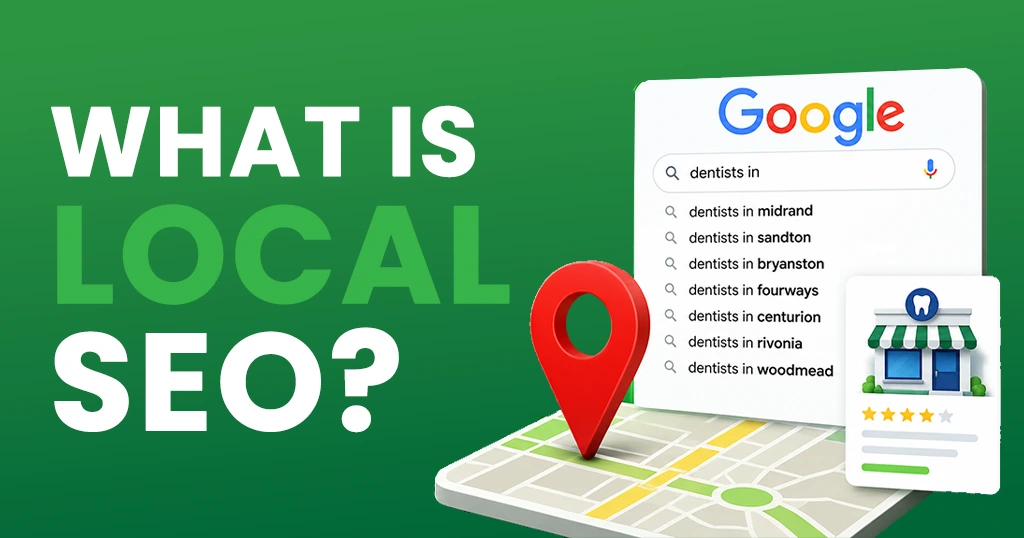
What is Local SEO — example showing a "dentist near me" Google Maps search with storefront and pin, Ranked by Moed
SEO

What Is Local SEO?

Local SEO is the process of helping your business appear when nearby customers search for what you offer — on Google Search, Google Maps, and increasingly, AI-powered search tools like ChatGPT and Gemini. If someone searches “plumber in Midrand,” “dentist near me,” or “solar installer Sandton,” local SEO determines whether your business shows up or your competitor gets the call instead. Unlike traditional SEO, which focuses on ranking nationally or globally, local SEO focuses on winning visibility in the specific cities, suburbs, and communities a business actually serves. For many South African businesses, Local SEO is the digital equivalent of having the best location on the busiest street in town. Why Local SEO Matters The way people discover local businesses has changed completely. Nobody drives around looking for signboards anymore — they pull out their phones. These are not casual searches. According to Google, 46% of all search queries have local intent, and 78% of people who search for something nearby on their phone visit that business within a day. When somebody in Sandton needs an electrician, or somebody in Durban wants dinner nearby, they search — and they usually act on what they find quickly. That makes local SEO one of the highest-intent marketing channels available. Unlike social media, where a business interrupts someone’s attention, local SEO places a business in front of people who are already looking for exactly what it offers. How Local SEO Works Google’s goal is simple: show the most useful nearby business. To do that, Google evaluates three primary factors. 01 Relevance Google wants to understand how closely your business matches what somebody is searching for. A plumbing company should appear for plumbing searches, not electrical searches. 02 Distance Google looks at where the searcher is located and how close your business is to that location. 03 Prominence This is Google’s measure of trust. Reviews, website authority, local mentions, business information, and online reputation all help Google determine whether your business deserves visibility. When these signals are strong, your chances of appearing in Google Maps, local search results, and location-based searches improve significantly. Who Needs Local SEO? Not every business depends on Local SEO equally. A software company selling internationally has very different needs from a plumber servicing Midrand. Businesses that rely on local customers benefit the most. This includes restaurants, coffee shops, dentists, doctors, mechanics, electricians, plumbers, locksmiths, solar installers, estate agencies, gyms, salons, retailers, attorneys, accountants, and many professional service providers. The common factor is simple: customers need to find them within a specific geographic area. A plumber does not need website visitors from London. A dentist in Pretoria does not need traffic from Durban. They need visibility where their customers actually are. Why These Businesses Need Local SEO Local businesses compete for attention at the exact moment somebody is ready to spend money. When a geyser bursts, nobody scrolls Instagram looking for a plumber. When somebody needs a family doctor, they rarely start on TikTok. When a visitor wants a restaurant nearby, they usually search Google Maps. These moments represent demand that already exists. Local SEO helps businesses capture that demand. Without it, competitors become visible while your business remains hidden. The Biggest Marketing Mistake Local Businesses Make Many South African businesses rely entirely on social media, word of mouth, or occasional advertising. The problem is that these channels create awareness but do not always capture existing demand. A Facebook page does not automatically help somebody find you when they search “electrician near me.” A beautiful website does not help if nobody discovers it. Paid advertising generates visibility, but the visibility disappears when the budget stops. The most successful local businesses build a balanced marketing strategy. Their website converts visitors. Social media builds awareness. Advertising generates immediate leads. Local SEO captures people already searching for solutions. What It Takes To Succeed With Local SEO Many business owners understand the value of Local SEO but want to know whether it is worth the investment. The answer depends on the industry, competition, and market opportunity. The Benefits Of Local SEO Strong Local SEO can generate: Unlike many marketing channels, Local SEO targets people with existing buying intent. These are not passive viewers. These are people actively searching for a solution. That is why Local SEO often produces higher-quality leads than many other forms of digital marketing. How Much Does Local SEO Cost In South Africa? Local SEO costs vary depending on the industry and competition. A small business in a less competitive area may spend between R2,000 and R5,000 per month. Businesses operating in highly competitive sectors such as legal services, medical practices, security, plumbing, or solar installation often invest between R5,000 and R15,000+ per month. Several factors influence pricing: A locksmith competing in Sandton faces a different challenge from a bakery serving a small town. The investment required reflects that reality. How Long Does Local SEO Take? Local SEO is not instant. Most businesses begin seeing meaningful progress within three to six months. Businesses with an established website and existing reputation may see improvements sooner. New businesses typically take longer because Google has less historical trust and data to work with. The important thing to understand is that Local SEO compounds. The work done today continues creating value long after it is completed. The Real ROI Of Local SEO The real return is not rankings. The real return is business growth. Better visibility leads to more enquiries. More enquiries create more opportunities. More opportunities generate more revenue. Unlike paid advertising, where every lead has a direct cost attached to it, Local SEO can continue generating enquiries long after the initial work has been completed. That makes it one of the few digital marketing investments that becomes more valuable over time. Local SEO In The AI Era Local search is changing faster than it has in years. Google AI Overviews, Google AI Mode, ChatGPT, Gemini, Perplexity, and other AI-powered search experiences are changing how people discover businesses. Instead of typing simple searches
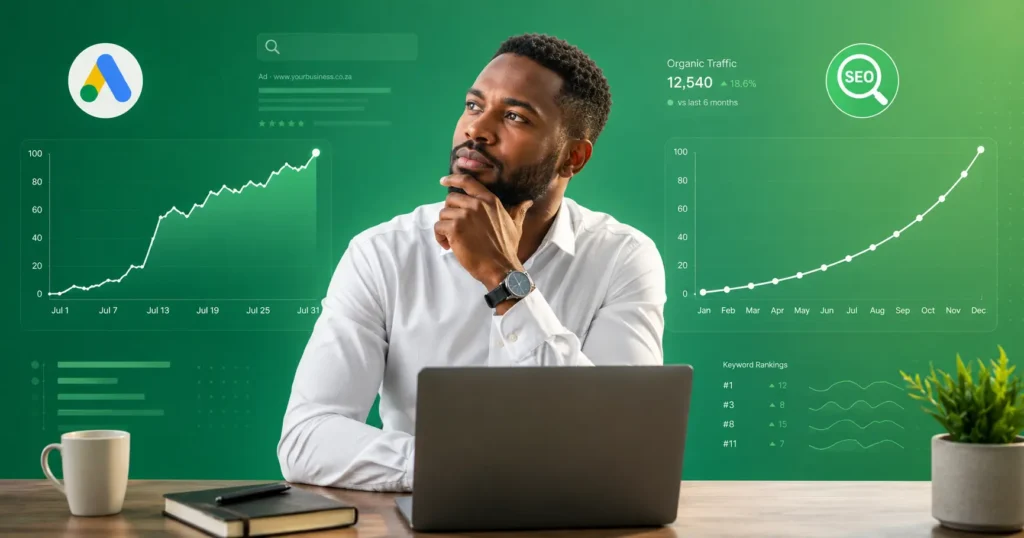
A Business owner choosing between Google paid ads or SEO
SEO

Google Ads vs SEO — Where Should Your Business Invest First?

Google Ads vs SEO — most business owners treat this as a budget question. It is not. It is a strategy question. Google Ads buys immediate visibility. SEO builds the foundation that makes everything perform — your organic rankings, your landing pages, and your paid ads. Whether you plan to run paid search or not, SEO comes first. Without it, you are spending money to send buyers to a destination that cannot convert them. What Google Ads Actually Does Google Ads lets your business pay to appear at the top of search results. You bid on keywords, choose your audience, set a budget, and pay when someone clicks. It is fast, measurable, and controllable. You can target specific locations, suburbs, times, devices, and buyer intent. But Google Ads is a tap. Turn it on and the traffic starts. Turn it off and the traffic stops. Businesses run Google Ads for specific objectives — generating leads, driving traffic, building awareness, or capturing local demand. Google uses machine learning to adjust how your ads operate based on the objective you select. The honest downside is cost. In South Africa, B2B clicks in competitive industries range from R25 to R150 per click. Generic broad keywords waste budget fast. People using one-word searches are usually researching, browsing, or looking for free information. They are rarely ready to buy. What SEO Actually Does SEO builds organic visibility so your business appears when buyers search, without paying for every click. Unlike Google Ads, SEO takes time. You improve your website, create useful content, strengthen technical performance, and build authority around the problems your buyers are searching for. A well-optimised page can generate enquiries for months or years after it is published. That is why I see SEO as an asset, not a tap. The downside is patience. Most South African B2B businesses should expect meaningful results within 4 to 9 months, depending on competition, domain age, and search demand. For B2B businesses specifically, SEO compounds differently than B2C. Corporate buyers do not make impulse decisions. They research for weeks. A business that ranks for the right terms and publishes useful content is building trust with procurement teams and decision-makers long before they ever contact Sales. The Key Difference Google Ads SEO Speed Fast. Clicks within days. Slower. Results in 4 to 9 months. Cost You pay per click. Upfront investment. No cost per organic click. When you stop Visibility disappears immediately. Strong pages keep bringing traffic over time. Best for Immediate leads, launches, urgent demand, and testing which messages work before committing to long-term content. Long-term visibility, trust, and authority — especially in B2B where buyers research extensively before contacting anyone. Long-term value Useful but dependent on ongoing spend. Compounds into a business asset. So Where Should You Start? Before choosing between Google Ads and SEO, understand three things first: your market, your product or service, and whether buyers are actively searching for it. If nobody is searching for what you do yet, Google Ads has nothing to capture. In that situation, your job is to create demand by publishing content around the problems your buyers already know they have. Start with Google Ads if: Start with SEO if: Do both — but SEO comes first either way.Whether you send paid traffic to your website or a dedicated landing page, SEO is not optional. The page needs to load fast, build trust quickly, and speak directly to the people you are targeting. Google also factors in landing page quality when determining your ad cost, a slow or poorly optimised page raises your cost per click and lowers your ad performance. Paid ads buy the handshake, but SEO optimization secures the deal. They are two sides of the same coin. What I Would Tell You If a business owner called me today, I would not say “do both” without understanding the business first. I would ask: what do you sell, who buys it, how urgently do you need leads, and is there active search demand for it? For most SMEs in South Africa, the business has never invested properly in SEO. My advice is to start there. Not because paid ads do not work — they do. But SEO fixes the foundation first. It makes sure that when buyers find you, they can actually choose you. There is no point running paid ads to a website or landing page that cannot convert. You are paying to send buyers to a broken sales process. Fix the foundation. Then add paid ads on top when the budget allows. The Right Order of Investment Invest in your website first. If you drive paid traffic to a slow or confusing page, you are paying to watch people leave. Phase 1 — Technical SEO and CRO: The FoundationFix your Page speed, mobile experience, clear headlines, trust signals. Without this, nothing else performs. Phase 2 — Run targeted Google AdsOnce the foundation is ready, run ads targeting bottom-of-funnel keywords — people actively looking to buy right now. Phase 3 — Build long-term SEOContent, authority, organic rankings. Takes 6 to 12 months but generates free traffic every day once it works. Most businesses want to start at Phase 2. The ones that get the best return start at Phase 1 If you are not sure which one makes sense for your business right now — book a strategy session with Ranked by Moed. We will look at where you are, what your buyers are searching for, and give you a clear recommendation. Questions our clients frequently ask us Can I invest in both SEO and paid ads at the same time? ⌄ Yes — and for many businesses this is the strongest approach. Google Ads captures demand immediately while SEO builds authority in the background. Over time, SEO reduces your dependency on paid spend. The key is sequencing them correctly based on your budget and what your business needs right now. Does Ranked by Moed run paid ads? ⌄ Ranked by Moed specialises

Two business professionals reviewing SEO strategy on a laptop — Ranked by Moed, Johannesburg
SEO

What Is SEO: Why does your business need it in 2026

SEO, or search engine optimisation, is the process of improving your online visibility so your business appears when potential customers search for products, services, or information related to what you offer. In 2026, SEO is no longer just about Google rankings. It determines whether buyers find your business, your competitor, or an AI-generated answer that never mentions you. Why This Matters for Your Business Every day, potential customers search for solutions online. If your business is not visible when those searches happen, you are not part of the buying conversation. Many South African businesses lose opportunities not because their products or services are inferior, but because they are difficult to find. Buyers cannot choose a business they never discover. Visibility influences consideration. Research habits have changed dramatically. Before contacting a supplier, buyers compare websites, read reviews, search for answers, and evaluate credibility. By the time they submit an enquiry, they often have a shortlist in mind. What Is SEO? SEO is the process of making your business easier to find, understand, and trust online. A simple way to think about SEO is to imagine Google as a concierge at a five-star hotel. Every day, people ask that concierge for recommendations. The concierge’s reputation depends on recommending the best option available. Your website is one of those options. SEO is the work you do to convince the concierge that your business deserves to be recommended. That means: SEO is not about tricking search engines. It is about making your business so relevant, useful, and trustworthy that search engines would struggle to justify recommending anyone else. How Search Engines Decide What to Show Search engines evaluate billions of web pages in seconds. Their goal is simple: provide the best possible answer to a user’s question. Relevance Search engines determine whether your content matches what someone is searching for. If a user searches for a specific service, they want the most relevant answer available. Your content must clearly address the problem being searched. Authority Search engines assess whether your business can be trusted. They look at factors such as expertise, reputation, backlinks, and brand credibility. Google increasingly evaluates content through the lens of Experience, Expertise, Authoritativeness, and Trustworthiness (E-E-A-T). User Experience A slow or frustrating website creates a poor experience. Search engines favour websites that are fast, mobile friendly, secure, and easy to navigate. Even great content can struggle if the website experience is poor. This is where keyword research and technical website optimisation become important. Internal link placeholder: “keyword research” → What Is a Keyword — And How Do Businesses Use Them to Get Found Internal link placeholder: “technical SEO” → What Is Technical SEO — And Does Your Website Need It A useful analogy comes from the builders of medieval cathedrals. They understood that the strength of the entire structure depended on the foundation beneath it. SEO works the same way. Without a strong technical foundation, even excellent content struggles to perform. Why South African B2B Businesses Need SEO South African B2B buying behaviour has changed significantly. Procurement teams, executives, and business owners now conduct extensive online research before engaging a supplier. Many decisions are influenced long before a discovery call or proposal request takes place. Buyers research before they enquire. Generate Higher-Quality Enquiries People using search engines are often looking for answers, suppliers, or solutions right now. This creates stronger commercial intent than many outbound marketing methods. When your business appears at the moment a buyer is searching, you are entering the conversation at the point of need. Capture Regional Search Demand South Africa is highly regionalised. A company serving Gauteng, Durban, Cape Town, or Rustenburg may benefit more from targeted local visibility than broad national awareness. Searches such as: often indicate strong buying intent. Establish Trust Required for Large Contracts B2B purchases often involve multiple stakeholders, lengthy evaluation processes, and significant budgets. Ranking prominently in search results helps signal credibility and stability. Supporting that visibility with useful content, case studies, and proof of expertise helps buyers feel confident moving forward. What an SEO Company in Johannesburg Actually Does Ranking Versus Generating Enquiries Ranking and generating enquiries are not the same thing. A ranking places your website in front of a potential customer. An enquiry turns that attention into a business opportunity. Visibility alone does not generate revenue. Many businesses rank well but struggle to generate leads because: The real goal of SEO is not rankings. The real goal is moving a buyer through four stages: At Ranked by Moed, this distinction matters. Businesses do not invest in SEO because they want first-page rankings. They invest because they want qualified enquiries, stronger market presence, and sustainable growth. What SEO Looks Like in 2026 SEO in 2026 extends far beyond traditional search results. Search visibility now exists across multiple environments. Traditional Search Google and Bing remain important sources of discovery. Businesses still need strong organic visibility for commercial and informational searches. Local Search Google Maps and Google Business Profiles influence purchasing decisions daily. For many service businesses, local visibility is just as important as website rankings. AI Search AI-powered search experiences are changing how information is consumed. Platforms such as ChatGPT, Gemini, Copilot, and Perplexity increasingly provide direct answers instead of simply presenting links. This has created a growing focus on AI search and Generative Engine Optimisation (GEO). Internal link placeholder: “AI search” → What Is GEO — Generative Engine Optimisation and Why B2B Businesses Need It Success increasingly depends on whether AI systems view your business as a credible source worth referencing. Businesses that publish original expertise, genuine experience, and useful insights are more likely to be cited and discovered across AI-powered platforms. People Also Ask How long does SEO take to work? SEO generally takes between four and six months to show measurable results, with stronger returns often appearing after twelve months. The timeline depends on competition, website quality, industry demand, and the authority of your domain. Is SEO worth it for small businesses? Yes. SEO allows small

Scroll to Top