

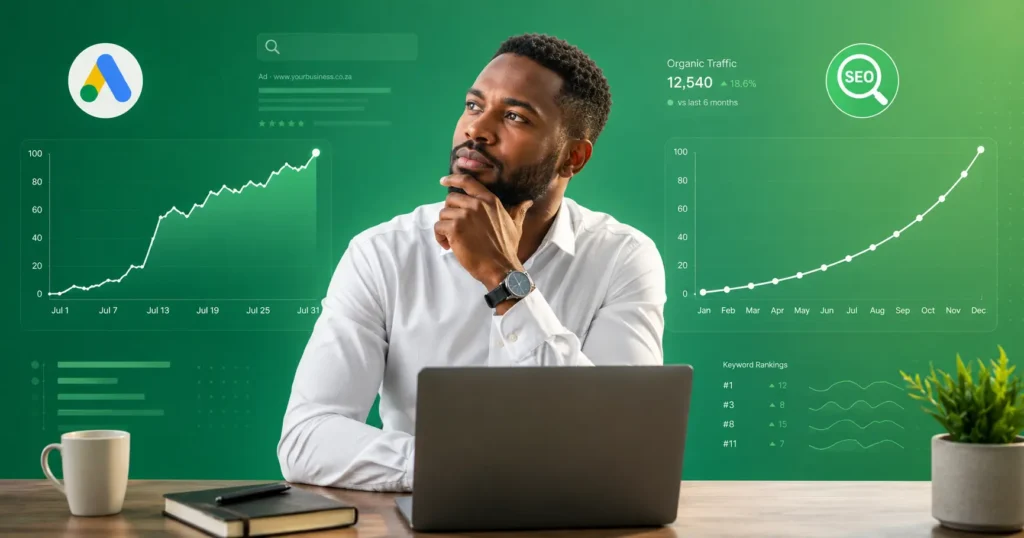
Google Ads vs SEO — most business owners treat this as a budget question. It is not. It is a strategy question. Google Ads buys immediate visibility. SEO builds the foundation that makes everything perform — your organic rankings, your landing pages, and your paid ads. Whether you plan to run paid search or not, SEO comes first. Without it, you are spending money to send buyers to a destination that cannot convert them.
What Google Ads Actually Does
Google Ads lets your business pay to appear at the top of search results.
You bid on keywords, choose your audience, set a budget, and pay when someone clicks. It is fast, measurable, and controllable. You can target specific locations, suburbs, times, devices, and buyer intent.
But Google Ads is a tap. Turn it on and the traffic starts. Turn it off and the traffic stops.
Businesses run Google Ads for specific objectives — generating leads, driving traffic, building awareness, or capturing local demand. Google uses machine learning to adjust how your ads operate based on the objective you select.
The honest downside is cost. In South Africa, B2B clicks in competitive industries range from R25 to R150 per click. Generic broad keywords waste budget fast. People using one-word searches are usually researching, browsing, or looking for free information. They are rarely ready to buy.
What SEO Actually Does
SEO builds organic visibility so your business appears when buyers search, without paying for every click.
Unlike Google Ads, SEO takes time. You improve your website, create useful content, strengthen technical performance, and build authority around the problems your buyers are searching for.
A well-optimised page can generate enquiries for months or years after it is published. That is why I see SEO as an asset, not a tap.
The downside is patience. Most South African B2B businesses should expect meaningful results within 4 to 9 months, depending on competition, domain age, and search demand.
For B2B businesses specifically, SEO compounds differently than B2C. Corporate buyers do not make impulse decisions. They research for weeks. A business that ranks for the right terms and publishes useful content is building trust with procurement teams and decision-makers long before they ever contact Sales.
The Key Difference
| Google Ads | SEO | |
|---|---|---|
| Speed | Fast. Clicks within days. | Slower. Results in 4 to 9 months. |
| Cost | You pay per click. | Upfront investment. No cost per organic click. |
| When you stop | Visibility disappears immediately. | Strong pages keep bringing traffic over time. |
| Best for | Immediate leads, launches, urgent demand, and testing which messages work before committing to long-term content. | Long-term visibility, trust, and authority — especially in B2B where buyers research extensively before contacting anyone. |
| Long-term value | Useful but dependent on ongoing spend. | Compounds into a business asset. |
So Where Should You Start?
Before choosing between Google Ads and SEO, understand three things first: your market, your product or service, and whether buyers are actively searching for it.
If nobody is searching for what you do yet, Google Ads has nothing to capture. In that situation, your job is to create demand by publishing content around the problems your buyers already know they have.
Start with Google Ads if:
- You need leads within 30 to 60 days
- You are launching into a new market or territory
- You need to test which messages resonate before investing in long-term content
- You have consistent monthly budget to maintain campaigns
Start with SEO if:
- You are building for the long term
- Your buyers research extensively before contacting anyone
- The cost per click in your industry makes paid ads financially unviable
- You want a marketing asset that compounds over time
Do both — but SEO comes first either way.
Whether you send paid traffic to your website or a dedicated landing page, SEO is not optional. The page needs to load fast, build trust quickly, and speak directly to the people you are targeting. Google also factors in landing page quality when determining your ad cost, a slow or poorly optimised page raises your cost per click and lowers your ad performance. Paid ads buy the handshake, but SEO optimization secures the deal. They are two sides of the same coin.
What I Would Tell You
If a business owner called me today, I would not say “do both” without understanding the business first.
I would ask: what do you sell, who buys it, how urgently do you need leads, and is there active search demand for it?
For most SMEs in South Africa, the business has never invested properly in SEO. My advice is to start there. Not because paid ads do not work — they do. But SEO fixes the foundation first. It makes sure that when buyers find you, they can actually choose you.
There is no point running paid ads to a website or landing page that cannot convert. You are paying to send buyers to a broken sales process. Fix the foundation. Then add paid ads on top when the budget allows.
The Right Order of Investment
Invest in your website first. If you drive paid traffic to a slow or confusing page, you are paying to watch people leave.
Phase 1 — Technical SEO and CRO: The Foundation
Fix your Page speed, mobile experience, clear headlines, trust signals. Without this, nothing else performs.
Phase 2 — Run targeted Google Ads
Once the foundation is ready, run ads targeting bottom-of-funnel keywords — people actively looking to buy right now.
Phase 3 — Build long-term SEO
Content, authority, organic rankings. Takes 6 to 12 months but generates free traffic every day once it works.
Most businesses want to start at Phase 2. The ones that get the best return start at Phase 1
If you are not sure which one makes sense for your business right now — book a strategy session with Ranked by Moed. We will look at where you are, what your buyers are searching for, and give you a clear recommendation.
Questions our clients frequently ask us
Yes — and for many businesses this is the strongest approach. Google Ads captures demand immediately while SEO builds authority in the background. Over time, SEO reduces your dependency on paid spend. The key is sequencing them correctly based on your budget and what your business needs right now.
Ranked by Moed specialises in SEO, website design, content, and AI search optimisation. We do not manage Google Ads campaigns. If a client needs paid search alongside their SEO strategy, we advise on the approach and can recommend a specialist. Our focus is on building the long-term digital infrastructure that generates consistent, qualified enquiries.
Start by understanding three things: your market, your product or service, and whether buyers are actively searching for it. In B2B, buying decisions are slow and research-heavy. If your buyers spend weeks evaluating options before contacting anyone, SEO is the stronger long-term investment — it builds trust with decision-makers before they ever reach out. If you need leads within 30 to 60 days, a focused Google Ads campaign with tight targeting can bridge the gap while SEO builds.
SEO that does not deliver usually has one of three problems: the wrong keywords were targeted, the website is not built to convert visitors into enquiries, or the work was inconsistent. SEO is not a switch you flip — it is a compounding process that requires strategy, patience, and consistent execution. At Ranked by Moed, we set realistic expectations upfront and track progress monthly so you always know what is happening and why.