

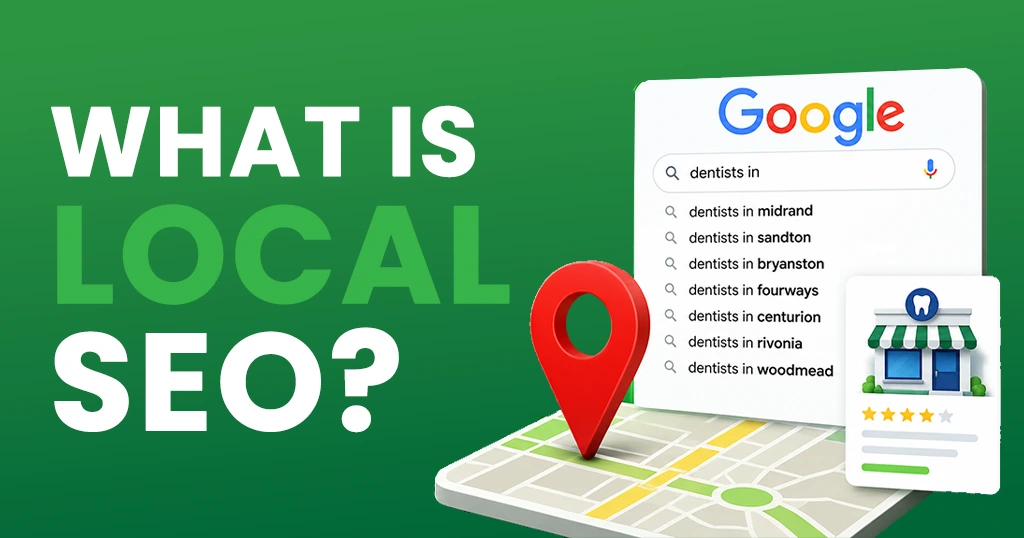
Local SEO is the process of helping your business appear when nearby customers search for what you offer — on Google Search, Google Maps, and increasingly, AI-powered search tools like ChatGPT and Gemini.
If someone searches “plumber in Midrand,” “dentist near me,” or “solar installer Sandton,” local SEO determines whether your business shows up or your competitor gets the call instead.
Unlike traditional SEO, which focuses on ranking nationally or globally, local SEO focuses on winning visibility in the specific cities, suburbs, and communities a business actually serves.
For many South African businesses, Local SEO is the digital equivalent of having the best location on the busiest street in town.
Why Local SEO Matters
The way people discover local businesses has changed completely. Nobody drives around looking for signboards anymore — they pull out their phones.
These are not casual searches. According to Google, 46% of all search queries have local intent, and 78% of people who search for something nearby on their phone visit that business within a day. When somebody in Sandton needs an electrician, or somebody in Durban wants dinner nearby, they search — and they usually act on what they find quickly.
That makes local SEO one of the highest-intent marketing channels available. Unlike social media, where a business interrupts someone’s attention, local SEO places a business in front of people who are already looking for exactly what it offers.
How Local SEO Works
Google’s goal is simple: show the most useful nearby business. To do that, Google evaluates three primary factors.
Google wants to understand how closely your business matches what somebody is searching for. A plumbing company should appear for plumbing searches, not electrical searches.
Google looks at where the searcher is located and how close your business is to that location.
This is Google’s measure of trust. Reviews, website authority, local mentions, business information, and online reputation all help Google determine whether your business deserves visibility.
Want your business to show up first in your area? See our Local SEO services, with packages from R3,500 per month.
Who Needs Local SEO?
Not every business depends on Local SEO equally.
A software company selling internationally has very different needs from a plumber servicing Midrand.
Businesses that rely on local customers benefit the most.
This includes restaurants, coffee shops, dentists, doctors, mechanics, electricians, plumbers, locksmiths, solar installers, estate agencies, gyms, salons, retailers, attorneys, accountants, and many professional service providers.
The common factor is simple: customers need to find them within a specific geographic area.
A plumber does not need website visitors from London.
A dentist in Pretoria does not need traffic from Durban.
They need visibility where their customers actually are.
Why These Businesses Need Local SEO
Local businesses compete for attention at the exact moment somebody is ready to spend money.
When a geyser bursts, nobody scrolls Instagram looking for a plumber.
When somebody needs a family doctor, they rarely start on TikTok.
When a visitor wants a restaurant nearby, they usually search Google Maps.
These moments represent demand that already exists.
Local SEO helps businesses capture that demand.
Without it, competitors become visible while your business remains hidden.
The Biggest Marketing Mistake Local Businesses Make
Many South African businesses rely entirely on social media, word of mouth, or occasional advertising.
The problem is that these channels create awareness but do not always capture existing demand.
A Facebook page does not automatically help somebody find you when they search “electrician near me.”
A beautiful website does not help if nobody discovers it.
Paid advertising generates visibility, but the visibility disappears when the budget stops.
The most successful local businesses build a balanced marketing strategy.
Their website converts visitors.
Social media builds awareness.
Advertising generates immediate leads.
Local SEO captures people already searching for solutions.
What It Takes To Succeed With Local SEO
Many business owners understand the value of Local SEO but want to know whether it is worth the investment.
The answer depends on the industry, competition, and market opportunity.
The Benefits Of Local SEO
Strong Local SEO can generate:
- More phone calls
- More website visits
- More enquiries
- More direction requests
- More bookings
- More foot traffic
- More local brand trust
Unlike many marketing channels, Local SEO targets people with existing buying intent.
These are not passive viewers.
These are people actively searching for a solution.
That is why Local SEO often produces higher-quality leads than many other forms of digital marketing.
How Much Does Local SEO Cost In South Africa?
Local SEO costs vary depending on the industry and competition.
A small business in a less competitive area may spend between R2,000 and R5,000 per month.
Businesses operating in highly competitive sectors such as legal services, medical practices, security, plumbing, or solar installation often invest between R5,000 and R15,000+ per month.
Several factors influence pricing:
- The competitiveness of your industry
- Your city or service area
- The number of locations you operate
- The condition of your current website
- Your existing online visibility
- The amount of work required to outrank competitors
A locksmith competing in Sandton faces a different challenge from a bakery serving a small town.
The investment required reflects that reality.
How Long Does Local SEO Take?
Local SEO is not instant.
Most businesses begin seeing meaningful progress within three to six months.
Businesses with an established website and existing reputation may see improvements sooner.
New businesses typically take longer because Google has less historical trust and data to work with.
The important thing to understand is that Local SEO compounds.
The work done today continues creating value long after it is completed.
The Real ROI Of Local SEO
The real return is not rankings.
The real return is business growth.
Better visibility leads to more enquiries.
More enquiries create more opportunities.
More opportunities generate more revenue.
Unlike paid advertising, where every lead has a direct cost attached to it, Local SEO can continue generating enquiries long after the initial work has been completed.
That makes it one of the few digital marketing investments that becomes more valuable over time.
Local SEO In The AI Era
Local search is changing faster than it has in years.
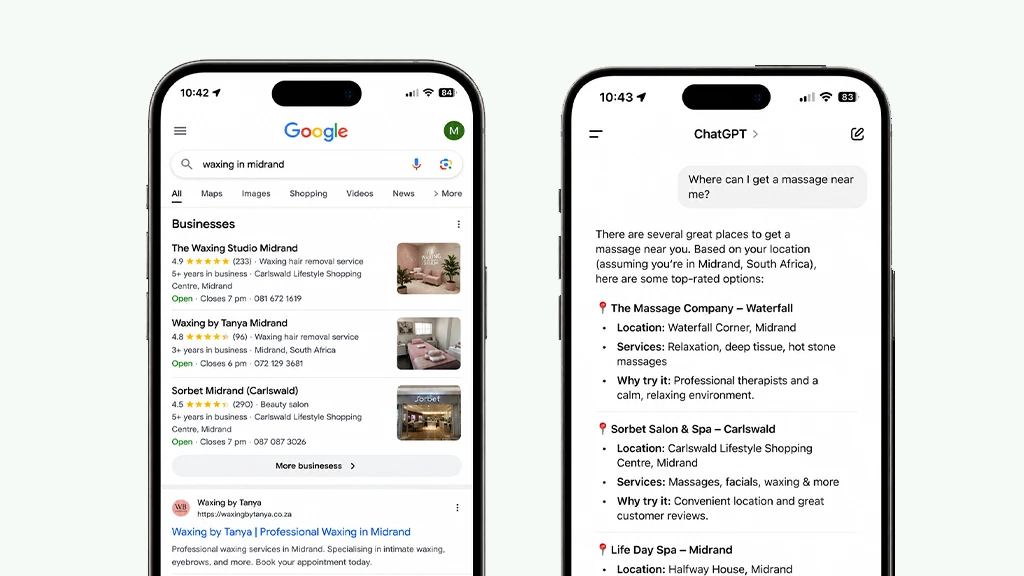
Google AI Overviews, Google AI Mode, ChatGPT, Gemini, Perplexity, and other AI-powered search experiences are changing how people discover businesses.
Instead of typing simple searches like “plumber Midrand,” users increasingly ask complete questions such as:
“Who is the best-rated plumber in Midrand that can help with a burst geyser?”
This changes what search engines need.
They no longer look only at keywords.
They look for evidence.
Local SEO Is Becoming Evidence SEO
One of the biggest shifts highlighted by local search experts such as Darren Shaw is that Local SEO is becoming less about optimisation and more about evidence.
AI systems want proof that your business is legitimate, active, trusted, and capable.
That proof comes from:
- Reviews
- Customer feedback
- Website content
- Local mentions
- Business information
- Photos
- Videos
- Consistent activity
Businesses that provide the strongest evidence become easier for AI systems to recommend.
Reviews Matter More Than Ever
A generic review saying “Great service” provides very little value.
A detailed review saying:
“They repaired our solar inverter in Randburg during load shedding and arrived within two hours”
gives both Google and AI systems valuable context.
The future belongs to businesses that collect detailed, authentic customer reviews consistently.
What Business Owners Should Expect
The fundamentals of Local SEO are not disappearing.
Google still wants to show relevant, nearby, trusted businesses.
What is changing is how trust is measured.
Businesses that maintain accurate information, collect reviews, publish useful local content, and build a strong digital footprint will increasingly dominate both traditional search results and AI-generated recommendations.
Conclusion
The most successful local businesses do not rely on one channel alone. A converting website builds trust once a visitor arrives. Social media builds awareness. Paid advertising generates immediate leads. Local SEO captures the people already searching for a solution — and unlike paid ads, that visibility does not disappear the moment the budget stops.