

83% of B2B decision-makers do their own independent research before ever talking to Sales. 51% of B2B buyers now start their research with AI tools before search engines. One third of buyers purchase from a vendor they have never heard of because of an AI recommendation.
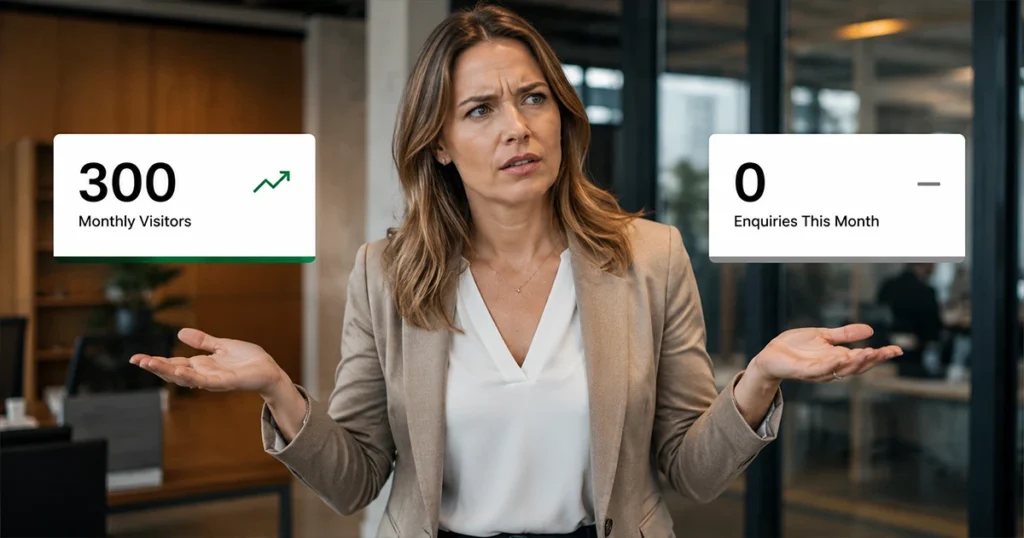
Your website is doing the selling long before you know a buyer exists. If visitors leave without contacting you, it is usually because something on your website creates doubt, confusion, or friction.
Source: SurveyMonkey, LinkedIn and G2 buyer behaviour research, 2026.
Most businesses still treat their website like a digital brochure. The best websites work as a 24-hour sales asset. A visitor lands on your website, evaluates your credibility, decides whether you understand their problem, and either contacts you or leaves. Most of that decision happens before you ever know they were there.
1. Your Website Doesn’t Explain What You Do Fast Enough
Most visitors leave because they cannot understand what a business does within seconds of landing on the website.
This is the first thing I look for when reviewing a site. If I need to scroll, click around, or interpret vague marketing language to understand what you actually do, there is already a problem.
Many websites lead with phrases like:
- Innovative solutions
- Excellence in service delivery
- Transforming businesses
- Industry-leading expertise
These statements sound impressive but explain nothing.
A visitor wants three questions answered immediately:
- What do you do?
- Who do you do it for?
- What should I do next?
If your homepage cannot answer those questions above the fold, people will simply return to search results and continue comparing alternatives.
I often tell clients that clarity beats creativity. A simple headline that clearly explains your value will outperform clever copy every time.
Clarity beats creativity.
Action: Ask someone outside your industry to visit your homepage for five seconds and explain what your business does.
2. Your Website Performs Poorly on Mobile
A poor mobile experience causes visitors to leave before they engage with your business.
Many business owners review their websites on large office monitors. Their buyers do not.
Most visitors are researching suppliers from a mobile device. They are travelling, sitting in meetings, comparing options between tasks, or searching after hours. If your website is difficult to use on mobile, they leave.
I regularly see websites where:
- Text overlaps
- Buttons are too small to tap
- Forms are difficult to complete
- Pages load slowly
- Navigation breaks on mobile devices
Google has operated on a mobile-first approach for years. That means the mobile version of your website often becomes the primary version evaluated by both users and search engines.
A visitor will tolerate very little friction on mobile. If they need to pinch, zoom, or wait for content to load, they will move on quickly.
3. Your Website Looks Like Every Other AI-Generated Website
Generic websites struggle to build confidence.
AI tools have made website creation faster than ever. The problem is that many businesses publish the first version and never improve it.
The result is usually the same:
- Generic headlines
- Generic stock photography
- Generic service descriptions
- Generic promises
Buyers notice this immediately.
I have seen dozens of websites claiming to be professional, trusted, reliable, customer-focused, and industry-leading. When everyone says the same thing, those words lose meaning.
What separates a business today is proof.
Show your team.
Show your work, process and results.
The businesses winning online are the ones demonstrating real expertise rather than simply claiming it.
Proof beats promises.
4. Visitors Cannot Find a Clear Next Step
Many websites lose enquiries because they create decision paralysis.
A visitor arrives ready to engage and immediately encounters:
- Contact Us
- Learn More
- Get Started
- Book a Demo
- Download Guide
- Request Information
All competing for attention.
When everything is important, nothing feels important.
One of the most effective website conversion tips I give clients is to choose one primary action and repeat it consistently throughout the website.
People scan websites. They do not read every word.
A strong website design businesses can learn from follows a predictable path:
Understand the problem → Build trust → Take action
Your call-to-action should feel obvious.
The visitor should never have to wonder what to do next.
5. Your Website Gives People Reasons to Doubt You
Trust determines whether visitors enquire or leave.
When I discover a business through social media, there is already some familiarity. If I discover that same business through search, I judge it much harder.
I want evidence.
I look for:
- Testimonials
- Case studies
- Client logos
- Team information
- Physical location
- Recent activity
If I cannot find those things, doubt appears quickly.
This becomes even more important in B2B environments where buying decisions involve larger budgets and greater risk.
Research published by Think With Google consistently shows that trust signals influence buying decisions throughout the customer journey.
A professional business website South Africa companies can trust should make credibility visible.
Visitors should not have to search for proof that your business is legitimate.
Trust must be visible.
6. Your Website Creates Too Much Friction
Every additional step reduces conversion rates.
Visitors do not enjoy filling out long forms. They do not enjoy hunting for contact details. They do not enjoy waiting for slow websites to load.
Research consistently shows that websites taking longer than three seconds to load experience significantly higher abandonment rates.
I recommend testing your website regularly using Google PageSpeed Insights and reviewing your Core Web Vitals metrics.
The most common friction points I see include:
- Long contact forms
- Hidden phone numbers
- Slow loading pages
- Poor navigation
- Broken links
- Difficult mobile experiences
Good website design businesses should aim for is often less about adding features and more about removing obstacles.
The easier you make it to contact you, the more enquiries you generate.
7. Your Website Was Built to Be Seen, Not to Generate Enquiries
Many websites focus on visibility but ignore conversion.
This is where I see the biggest disconnect.
Businesses celebrate:
- More traffic
- Better rankings
- More impressions
Yet enquiries remain unchanged.
Traffic alone is not success.
A website should move visitors through four stages:
- Visibility
- Trust
- Consideration
- Enquiry
Miss one stage and the process breaks.
This is why I always view websites and SEO as connected disciplines.
Search gets people to your website. Your website must then earn the enquiry.
The same principle applies to AI search.
AI platforms can introduce your business to buyers. Your website still has to convince them.
The businesses winning today are not necessarily the ones getting the most visitors. They are the ones creating the least resistance between interest and action.
Conclusion
Most businesses assume visitors leave because they are not interested.
My experience says otherwise.
More often, visitors leave because they cannot quickly understand what you do, they do not trust what they see, or they encounter unnecessary friction along the way.
The good news is that these problems are fixable.
When your website clearly communicates value, builds trust, and creates a simple path to action, conversion rates improve naturally.
Your website is often the first sales conversation a buyer has with your business. Make sure it is doing its job.